
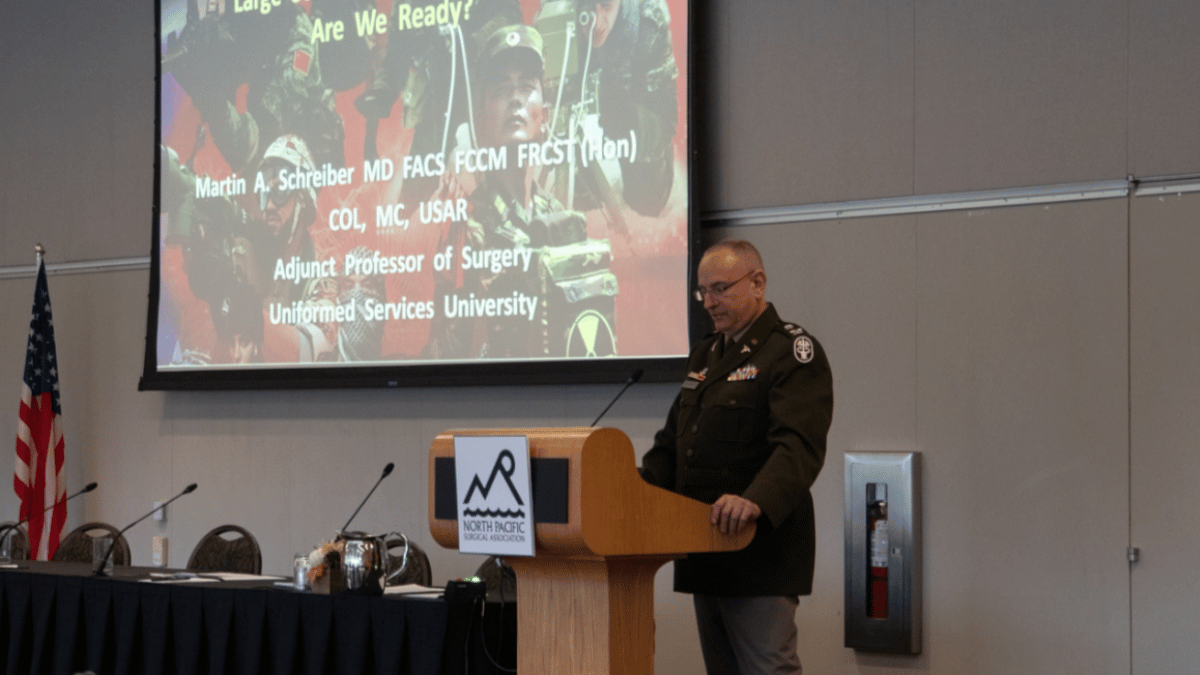

A number of surgeons in the Pacific Northwest and Western Canada met in Banff in late November to explore ways that the civilian and military trauma systems need to change to respond to future emergencies. About 150 physicians from Washington State, Oregon, Idaho, British Columbia and Alberta attended the 2015 Annual Meeting of the North Pacific Surgical Association (NPSS).
Dr. Martin A. Schreiber, a trauma surgeon from Portland and adjunct professor of surgery at the Uniformed Services University, delivered the keynote address, entitled “Large Scale Combat Operations: Are we ready?” This address discussed medical issues that military and civilian medical leaders should be aware of if global tensions escalate and new types of conflicts develop.
For over 40 years, Dr. Schreiber has worked between military and civilian trauma medicine. Dr. Schreiber graduated with honors from the University of Chicago and received his Doctor of Medicine degree from Case Western Reserve University School of Medicine. Currently, he is a colonel in the United States Army Reserve and has deployed to Iraq and Afghanistan, where trauma teams frequently must take action within minutes to prevent death from uncontrolled blood loss.
Prior to serving in the U.S. Army Reserve, Dr. Schreiber was the chair of the Division of Trauma, Critical Care, and Acute Care Surgery at Oregon Health & Science University for more than a decade. Under his leadership, OHSU’s trauma program became a national leader in trauma innovation. Dr. Schreiber is one of the most published authors in peer-reviewed literature on hemorrhage control and improving outcomes prior to operating room entry, having authored over 450 papers.
During his presentation, he outlined advances in trauma medicine developed in battlefield settings and transferred to hospitals in America. Tourniquets, once discouraged in emergency medicine due to concerns about unintended complications, are now credited with saving thousands of lives from uncontrolled bleeding. In addition, whole blood transfusion has reemerged as a life-saving option for patients in shock, early use of tranexamic acid has changed the approach to traumatic brain injury, and the strategy known as damage control resuscitation prioritizes bleeding control to prevent organ failure.
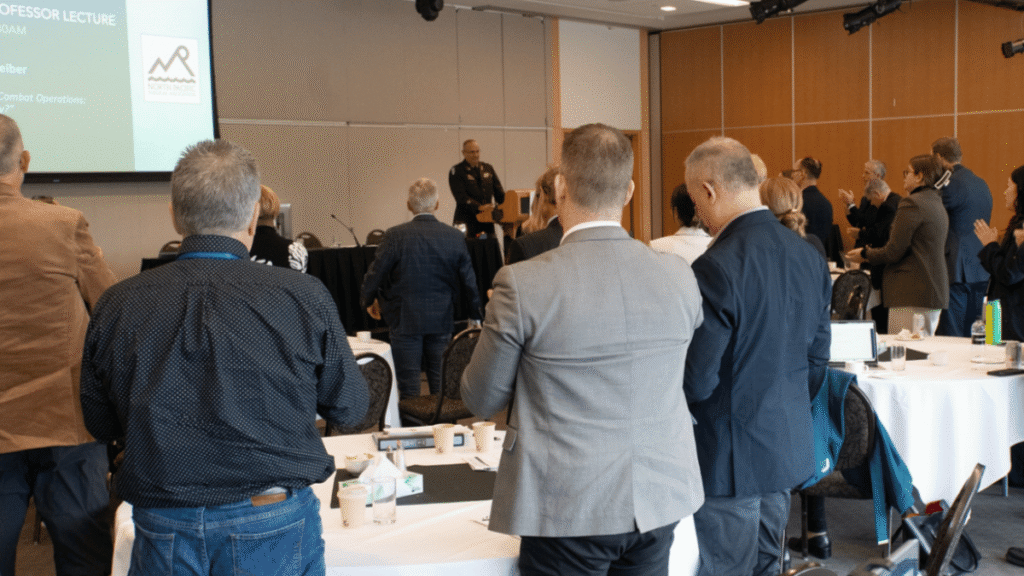
Dr. Schreiber stated that these advances were developed out of necessity during the wars of the last two decades; however, the gains now help people injured in car crashes, shootings, construction accidents, etc. However, Dr. Schreiber also warned that the next conflict may create pressures that existing systems will not be able to absorb.
He described potential challenges, including prolonged casualty care, limited evacuation options, and restricted access to medical supplies. He stated that community hospitals, especially those located in rural areas, may receive large numbers of patients before they can be transferred to major trauma centers. Dr. Schreiber said that planning must be strengthened now rather than in the middle of a crisis.
Audience questions focused on logistics, training, and blood availability. Several surgeons said afterward that the talk raised real and urgent issues that deserve continued national attention.
Dr. Schreiber closed by saying that while trauma medicine has made remarkable progress, the question of readiness remains unsolved. Dr. Schreiber said that systems must be prepared for emergencies ahead of time, not just for those already overcome.
About Dr. Martin A. Schreiber
Dr. Schreiber is a trauma surgeon in Portland and a colonel in the U.S. Army Reserve. He is an adjunct professor of surgery at the Uniformed Services University and previously led the trauma and critical care program at Oregon Health and Science University. Dr. Schreiber is recognized internationally for his work in trauma resuscitation and hemorrhage control, and for helping bring military medical advances into civilian hospitals.