
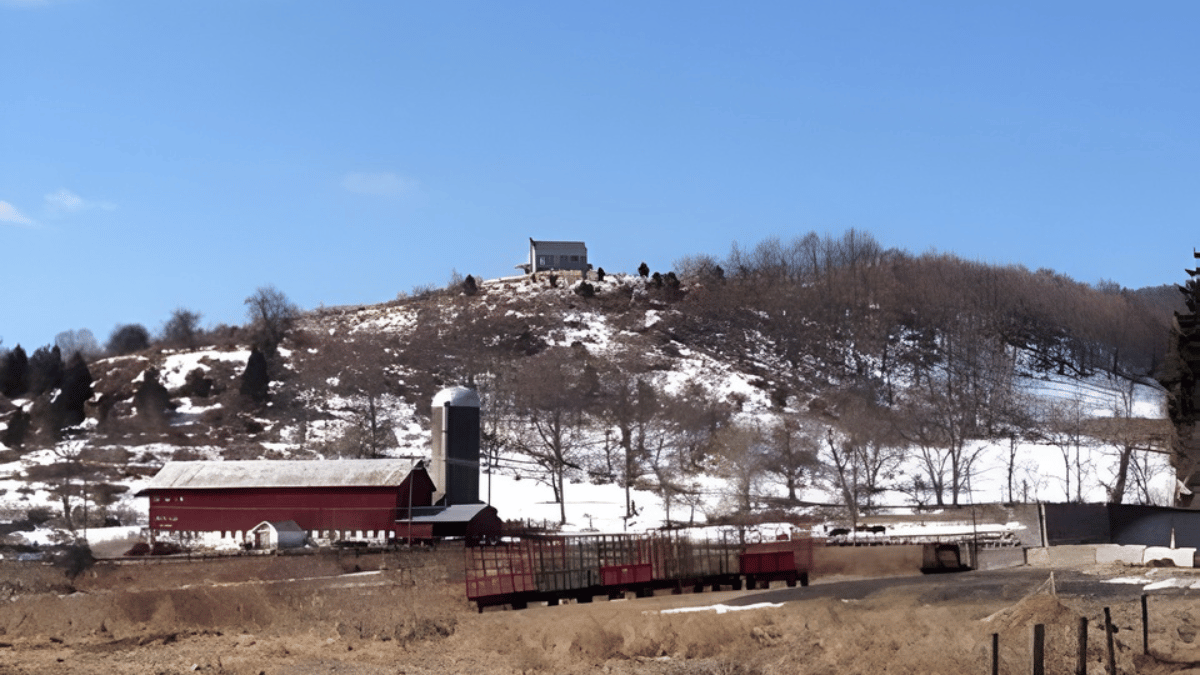

Although there is not much volcanic activity in New Jersey, one of the most popular sites that sparks curiosity about a possible volcano is in Sussex County. This site is known as Rutan Hill and is sometimes called “the Beemerville Volcano,” which leads people to wonder whether New Jersey has any volcanoes.
Yes, New Jersey has a volcano; however, it’s not what most people would think of as a volcano.
What is Rutan Hill?
Rutan Hill is a geologic formation located in rural Sussex County close to the village of Beemerville. It stands above the rest of the area, offering beautiful views of farmland and wooded areas. Due to its size and location, the majority of Rutan Hill has become residential property in recent decades.
Rutan Hill is generally classified as a volcano; however, it is not an active or dangerous volcano. Instead, Rutan Hill has been inactive or dormant for hundreds of millions of years.
Why is it called a volcano?
Geologists identify Rutan Hill as a geologic feature formed by volcanic processes that occurred in the past, when the area that is currently New Jersey was experiencing tectonic activity. Rutan Hill is primarily composed of igneous rock; igneous rocks form from magma below Earth’s surface.
Afterward, weathering (erosion) removed the softer surrounding rock, leaving the harder volcanic material on top of the hill. The weather also gave Rutan Hill its unique form and elevation, which is why it is sometimes identified as a volcano.
Where did the name “Beemerville Volcano” originate?
The term “Beemerville Volcano” refers to the nearby town of Beemerville. It is a term that has existed primarily because of local curiosity rather than because the scientific community has formally identified Rutan Hill as a volcano.
Has the volcano erupted recently?
There is no volcanic activity occurring anywhere in New Jersey at present. Rutan Hill is considered very dormant and poses no threat of a volcanic eruption.
The volcanic activity that formed Rutan Hill occurred hundreds of millions of years ago, long before the existence of dinosaurs or modern continents.
What does the land look like today?
Due to Rutan Hill’s elevation and views, it has attracted more housing developments and private ownership than preservation as a tourist attraction. Much of Rutan Hill is covered with homes, private property, and restricted access areas, which limits public access to the site and makes it less visible to the public compared to other geologic features.
Although Rutan Hill has attracted little attention as a tourist destination, the hill remains of interest to geologists and local residents who appreciate its unique place in New Jersey’s natural history.
A reminder of the hidden geology of New Jersey
Even though New Jersey does not have volcanoes in the same sense as Hawaii or the Pacific Northwest, Rutan Hill serves as a reminder that New Jersey’s landscape has been shaped by powerful geological forces that existed long before our current era of highways and suburban communities.
From ancient volcanic formations to glacial valleys and layered, fossil-rich rocks, New Jersey’s geology tells a story that is rarely noticed beneath New Jersey’s highway and suburban image.